Buy digitaltrends.eu ?
We are moving the project
digitaltrends.eu .
Are you interested in purchasing the domain
digitaltrends.eu ?
domain@kv-gmbh.de · 0541-91531010
Buy digitaltrends.eu ?
When do you use il faut and il ne faut pas?
"Il faut" is used to express what is necessary or required, while "il ne faut pas" is used to express what is not allowed or should be avoided. For example, you would use "il faut" to say "il faut étudier pour réussir" (it is necessary to study to succeed), and "il ne faut pas" to say "il ne faut pas fumer dans ce lieu" (smoking is not allowed in this place). These expressions are used to give advice, make recommendations, or set rules. **
What is the difference between il faut que and il faut?
"Il faut" is used to express a general necessity or obligation, while "il faut que" is used to introduce a specific action or event that is necessary or required. For example, "il faut manger" means "it is necessary to eat" in a general sense, while "il faut que tu manges" means "you need to eat" in a specific sense. "Il faut" is used to make a general statement about what is necessary, while "il faut que" is used to specify what needs to be done. **

Similar search terms for Chiarlo-Michele-Nebbiolo-Il
Top-Angebote
Products related to Chiarlo-Michele-Nebbiolo-Il:
-
Chiarlo Michele Nizza 'I Cipressi' Michele Chiarlo 2023Il Nizza “I Cipressi” è un vino rosso piemontese che colpisce sin dai primi momenti per la propria eleganza, veicolata al naso e al palato con un’ottima nettezza di profumi e sapori. Si tratta di una bottiglia a base di Barbera, varietà importante nel panorama ampelografico offerto dal Piemonte, che, dopo la vinificazione, viene sottoposta a un duplice affinamento, prima in legno e poi in vetro, per aumentare la propria espressività e incisività. Un’etichetta che si beve con grande piacevolezza, e che si abbina a diverse tipologie di piatti e ricette. Questo “I Cipressi” Nizza nasce da un 100% di uve Barbera, vitigno che, all’interno del terroir piemontese, è presente in diverse aree. Le viti di questa varietà vengono coltivate dal team della cantina Michele Chiarlo in vigneti situati a un’altezza ricompresa fra i 230 e i 280 metri sul livello del mare, esposti verso sud-est e sud-ovest. Il terroir è caratterizzato dalle cosiddette “sabbie astiane”, ricche di marne argilloso-calcaree. Gli acini, dopo la vendemmia, fermentano alcoolicamente in acciaio, macerando per 10-12 giorni. Poi si procede con la fase dell’affinamento, svolto dapprima per 12 mesi in botte grande, e poi, dopo l’imbottigliamento, per ulteriori 6 mesi in vetro. Il vino rosso Nizza “I Cipressi” si rivela all’occhio con un colore compatto e profondo, che richiama la tonalità del rubino. Il ventaglio di profumi che si sviluppa al naso è ordinato e pulito, e prospetta note di tabacco, frutta rossa e aromi che tendono allo speziato. All’assaggio è di buon corpo, pieno, con un sorso contraddistinto da una piacevole vena fresca, che, sul finale, vira verso un gusto lievemente minerale. Una bottiglia senza dubbio di ottimo livello, come testimoniano i recenti punteggi assegnatele da diverse guide italiane e internazionali.14,00 £*Shipping: 48,00 £Secure redirect to the provider
-
Chiarlo Michele Barbera d'Asti 'Palas' Michele Chiarlo 2024The Barbera d'Asti “Palas” by Michele Chiarlo is a tasty and refreshing red, produced by one of the true legends of the Langhe wine region. It is impossible not to connect a vocated terroir like that surrounding the Barolo area to the faces that have made its history, thanks to memorable and granite-like interpretations, and Michele Chiarlo is undoubtedly one of them. Since the first harvest, dating back to 1958, Michele has had clear ideas about the goals to pursue in the vineyard and in the cellar, and with an inspiring guide like his father, he has managed to significantly extend the vineyard heritage to about 60 hectares today, while continuing to offer us interpretations of great classicism and territorial adherence. An everlasting and essential classic. The “Palas” Barbera d’Asti is obtained from pure grapes of the same name, from vineyards that rest on calcareous clay soils, with a good presence of sand. In the vineyard, we strive to respect the natural balance of the place as much as possible, through a integrated pest management and paying great attention to the ripeness of the grapes. In the cellar, fermentation continues in steel tanks and 10 days of maceration on the skins, followed by aging always in steel for at least 3 months. The wine “Palas” presents itself in the glass with an intense ruby color edged with violet reflections. On the olfactory impact, the liquid reveals itself fresh and clean, with notes of fresh fruit such as blueberry and raspberry, and floral hints of violet, presenting itself in a direct and engaging manner. The sip is juicy and agile, endowed with remarkable drinkability and a truly wide gastronomic versatility, so much so that it finds its realization both on grilled meats and on a plate of mussels in sauce. One bottle is definitely too little!11,00 £*Shipping: 48,00 £Secure redirect to the provider
-
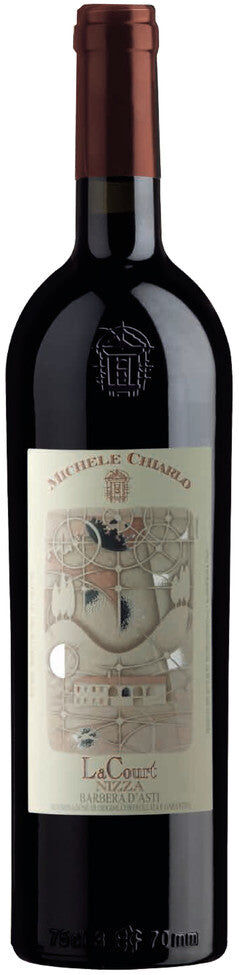
Chiarlo Michele Nizza Riserva 'La Court' Michele Chiarlo 2019Il vino Barbera d’Asti Superiore Nizza “La Court” prende il proprio nome dal cru di provenienza, un vero e proprio palcoscenico unico per le potenzialità del vitigno Barbera. Qui, infatti, quest’uva riesce ad assumere caratteristiche particolari, che uniscono struttura, longevità ed eleganza, dando origine a una danza di profumi e sapori che sconvolge sin dai primi istanti. Un rosso con cui Michele Chiarlo continua il proprio filone d’eccellenza, fatto di etichette che, all’interno di ogni territorio, ne raccontano solo il meglio. La Barbera d’Asti Superiore Nizza “La Court” nasce dall’utilizzo in purezza di uno dei vitigni più presenti all’interno del terroir vitivinicolo piemontese, la Barbera. Le viti di questa varietà vengono coltivate dal team di Michele Chiarlo all’interno di uno dei crus più importanti dell’intero Monferrato, il La Court, caratterizzato da un terreno composto da marne argillose e calcaree, in cui abbondano sabbia e limo. Qui la cantina coltiva 3 ettari di vigneti, situati a un’altezza di 240 metri sul livello del mare ed esposti verso sud e sud-ovest. Le uve, accuratamente selezionate, fermentano per 12 giorni in tini di legno di rovere, per poi maturare, sia in barrique che in botte grande, per un anno. Il “La Court” è una Barbera d’Asti Superiore Nizza che, al calice, si presenta con un tipico colore rosso rubino, attraversato da lampi più purpurei nell’unghia. Il naso è dominato da note di piccola frutta rossa matura, da cui emergono sensazioni più profonde che rimandano alle spezie e al boisé. In bocca è ampio, morbido, con un corpo strutturato e rotondo, quasi tattile; il sorso si contraddistingue per una piacevole vena fresca, che rende la beva scorrevole. Una delle etichette più rappresentative realizzate dalla cantina Michele Chiarlo, che, vendemmia dopo vendemmia, si conferma sempre su ottimi livelli qualitativi.51,00 £*Shipping: 48,00 £Secure redirect to the provider
-
Chiarlo Michele Barbera d'Asti 'Le Orme' Michele Chiarlo 2024Michele Chiarlo's Barbera d'Asti "Le Orme" is a fruity, cheerful, carefree red that infects anyone who uncorks a bottle with its vivacity. Alone or in company, this wine can generate a wonderful atmosphere with the enthralling intensity of its fruit. The freshness component gives it a beautiful drinkability, making it perfect to accompany various courses or even simply as an aperitif. It takes its name from the total ripening period it needs to be vinified, thus underlining the path that brings these grapes of strong territorial connotation into the bottle. "Le Orme" Barbera d'Asti by Michele Chiarlo comes from a selection of vineyards in the south of Asti, to be precise from the plots of Podere La Court and Montemareto in Castelnuovo Calcea, La Serra in Montaldo Scarampi and Costa delle Monache in Agliano. The soils are commonly identified as Asti sands, light-coloured soils of marine sedimentary origin, abundant in silt and microelements. Harvesting is carried out manually. This is followed by vinification consisting of 10 days of maceration in contact with the skins, alcoholic fermentation and malolactic fermentation, all in steel tanks. An ageing period of 16 months precedes bottling and marketing. Michele Chiarlo Barbera d'Asti "Le Orme" presents itself with a ruby red colour with violet reflections. Raspberry and crunchy cherry introduce the bouquet, which then opens to a spicy texture. In the mouth, it confirms the character of the fruit and manifests itself in its fresh, drinkable connotation of absolute pleasantness. The harder sides are made up of a fresh and savoury weave, which leaves the tannin in a barely perceptible way, perfectly integrated with the rest of the body. Suitable anytime, anywhere.13,00 £*Shipping: 48,00 £Secure redirect to the provider



-
Why is it souhaite-t-il and not souhaite-s-il?
In French, the pronoun "il" (he) is combined with the verb "souhaiter" (to wish) to form the phrase "souhaite-t-il" because of the rule of verb inversion in interrogative sentences. When forming a question in French, the subject pronoun and the verb are inverted, so "souhaite-t-il" follows this rule. The "t" is added to create a liaison between the verb and the pronoun, making the pronunciation smoother. **
-
What comes after il faudrait in French?
In French, "il faudrait" is followed by the infinitive form of a verb. This construction is used to express a suggestion or a polite request. For example, "il faudrait partir tôt" means "it would be necessary to leave early." **
-
How does "il faut" work in French?
"Il faut" is a common expression in French that is used to convey the idea of necessity or obligation. It is followed by an infinitive verb and is used to express what needs to be done or what is necessary in a given situation. For example, "Il faut manger" means "It is necessary to eat." This expression is used to give advice, make suggestions, or express general truths. **
-
What is an El, Sl, and Il?
An El, Sl, and Il are all suffixes used in the English language to form adjectives. "El" is used to form adjectives that mean "pertaining to" or "characterized by," such as in the word "musical." "Sl" is used to form adjectives that mean "tending to" or "inclined to," such as in the word "careful." "Il" is used to form adjectives that mean "having the nature of" or "capable of," such as in the word "flexible." These suffixes help to create new adjectives by modifying the meaning of the base word. **
What do the abbreviations el and il mean?
The abbreviation "el" typically stands for "elevated" and is commonly used in the context of transportation systems, such as an "el train" which refers to an elevated railway. On the other hand, "il" is often used as an abbreviation for "Illinois," which is a state in the United States. It can also be used as an abbreviation for "in-line" in various contexts, such as in sports or technology. **
What is your opinion of Kim Il Sung?
As an AI language model, I do not have personal opinions. However, I can provide information on Kim Il Sung. Kim Il Sung was the founding leader of North Korea and is revered as the country's eternal president. He is credited with leading the country's struggle for independence from Japanese colonial rule and establishing the regime that still governs North Korea today. However, his leadership is also associated with a cult of personality and a repressive regime that has been criticized for human rights abuses and isolationism. **
Top-Angebote
Products related to Chiarlo-Michele-Nebbiolo-Il:
-
Chiarlo Michele Nebbiolo 'Il Principe' Michele Chiarlo 2024“Il Principe” by Michele Chiarlo is a Nebbiolo worthy of the name it bears. Enriched by a soul and a noble character, just as noble are its tannins and its expressive potential. In the presence of the King of wines – Barolo – this pure Nebbiolo could only be defined as a prince. It comes from the youngest vineyards, but already rich in a charm that can only flourish with the passing of the years. One of the most skilled and historic hands of the Langa will guide them best on this fascinating journey. Each label of Chiarlo is the result of an intimate bond between the terroir and the vineyard, which is constantly studied and evaluated. The Nebbiolo “Il Principe” by Michele Chiarlo is made from grapes coming from both the Barbaresco area and the Roero area. In the former, the vines draw from a marl-limestone soil of gray and bluish color; in the latter, however, from loose and sandy soils. After a summer thinning of the bunches, the harvest takes place manually during the month of October. The alcoholic fermentation takes place in steel containers, as does the malolactic fermentation. It follows a phase of overall aging of 12 months, divided between steel, wood, and bottle.takes place in steel containers, as does the malolactic fermentation. It follows a phase of overall aging of 12 months, divided between steel, wood, and bottle. Michele Chiarlo Nebbiolo “Il Principe” is a red wine with a brilliant garnet hue. Its aroma unfolds with notes of red fruits, violet, and a spicy trail as a backdrop. On the palate, it is balanced, endowed with good structure and vibrant freshness, softened by a fine tannin that gives rise to an elegant sip. It finishes with a precise yet velvety finish, which is memorable in its silky tannic perception and crunchy fruit. A wine that knows how to combine simplicity and character; perfect for all occasions and always capable of surprising.17,00 £*Shipping: 48,00 £Secure redirect to the provider
-
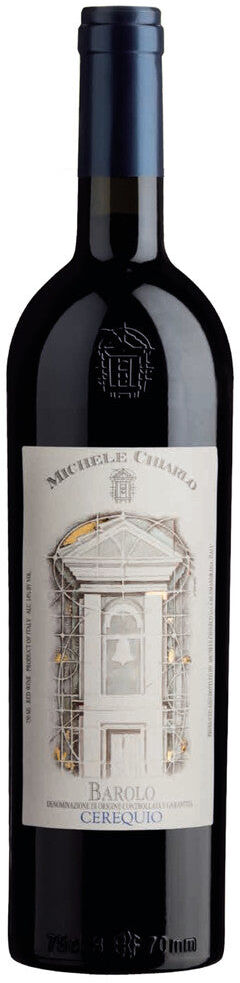
Chiarlo Michele Barolo 'Cerequio' Michele Chiarlo 2018Questo Barolo “Cerequio” fa rivivere, sorso dopo sorso, una delle zone più vocate alla viticoltura delle Langhe piemontesi. Cerequio è infatti una fra le più prestigiose menzioni geografiche aggiuntive dell’intera denominazione del Barolo, dove la cantina Michele Chiarlo può vantarsi di possedere ben 3 ettari di vigneti. Da questa terra nasce un vino rosso strutturato, dove il sorso colpisce il palato con incisività ed espressività, raccontando il profilo migliore dell’uva utilizzata, il Nebbiolo. Un’etichetta che mette d’accordo il parere della critica mondiale, e che va riservata a quelle occasioni dove ciò che si beve ha la sua importanza. Il vino “Cerequio” è un Barolo che nasce dalle uve di Nebbiolo coltivate proprio all’interno del cru di Cerequio, uno dei più prestigiosi dell’intera DOCG, i cui suoli sono tra i più antichi delle Langhe. Siamo all’interno di un terroir di formazione tortoniana, dove dominano marne calcaree; i vigneti della cantina Michele Chiarlo sono orientati verso sud e sud-ovest, e le piante hanno un’età media di circa 30-40 anni. Gli acini, una volta raccolti durante la vendemmia, fermentano alcoolicamente in tini di rovere, macerando per 20 giorni. Si procede poi con la fase di maturazione, in cui il vino rimane dapprima per 24 mesi in botti di rovere, e poi, dopo l’imbottigliamento, per altri 12 mesi in vetro. Il Barolo “Cerequio” si manifesta all’occhio con un colore tipicamente rubino, limpido e accattivante, connotato da leggeri riflessi tendenti al granato nell’unghia. Affascinante il ventaglio di profumi che si spiegano lentamente al naso, dove fiori appassiti si alternano alla piccola frutta matura e a sensazioni più balsamiche e mentolate. In bocca è di ottimo corpo, muscolare, con un sorso in cui dominano un tannino elegante e un gusto piacevolmente fresco. Un rosso che non necessita di troppe parole quanto di un assaggio concentrato, teso ad assaporarne appieno le qualità.97,00 £*Shipping: 48,00 £Secure redirect to the provider
-
Chiarlo Michele Nizza 'I Cipressi' Michele Chiarlo 2023Il Nizza “I Cipressi” è un vino rosso piemontese che colpisce sin dai primi momenti per la propria eleganza, veicolata al naso e al palato con un’ottima nettezza di profumi e sapori. Si tratta di una bottiglia a base di Barbera, varietà importante nel panorama ampelografico offerto dal Piemonte, che, dopo la vinificazione, viene sottoposta a un duplice affinamento, prima in legno e poi in vetro, per aumentare la propria espressività e incisività. Un’etichetta che si beve con grande piacevolezza, e che si abbina a diverse tipologie di piatti e ricette. Questo “I Cipressi” Nizza nasce da un 100% di uve Barbera, vitigno che, all’interno del terroir piemontese, è presente in diverse aree. Le viti di questa varietà vengono coltivate dal team della cantina Michele Chiarlo in vigneti situati a un’altezza ricompresa fra i 230 e i 280 metri sul livello del mare, esposti verso sud-est e sud-ovest. Il terroir è caratterizzato dalle cosiddette “sabbie astiane”, ricche di marne argilloso-calcaree. Gli acini, dopo la vendemmia, fermentano alcoolicamente in acciaio, macerando per 10-12 giorni. Poi si procede con la fase dell’affinamento, svolto dapprima per 12 mesi in botte grande, e poi, dopo l’imbottigliamento, per ulteriori 6 mesi in vetro. Il vino rosso Nizza “I Cipressi” si rivela all’occhio con un colore compatto e profondo, che richiama la tonalità del rubino. Il ventaglio di profumi che si sviluppa al naso è ordinato e pulito, e prospetta note di tabacco, frutta rossa e aromi che tendono allo speziato. All’assaggio è di buon corpo, pieno, con un sorso contraddistinto da una piacevole vena fresca, che, sul finale, vira verso un gusto lievemente minerale. Una bottiglia senza dubbio di ottimo livello, come testimoniano i recenti punteggi assegnatele da diverse guide italiane e internazionali.14,00 £*Shipping: 48,00 £Secure redirect to the provider
-
Chiarlo Michele Barbera d'Asti 'Palas' Michele Chiarlo 2024The Barbera d'Asti “Palas” by Michele Chiarlo is a tasty and refreshing red, produced by one of the true legends of the Langhe wine region. It is impossible not to connect a vocated terroir like that surrounding the Barolo area to the faces that have made its history, thanks to memorable and granite-like interpretations, and Michele Chiarlo is undoubtedly one of them. Since the first harvest, dating back to 1958, Michele has had clear ideas about the goals to pursue in the vineyard and in the cellar, and with an inspiring guide like his father, he has managed to significantly extend the vineyard heritage to about 60 hectares today, while continuing to offer us interpretations of great classicism and territorial adherence. An everlasting and essential classic. The “Palas” Barbera d’Asti is obtained from pure grapes of the same name, from vineyards that rest on calcareous clay soils, with a good presence of sand. In the vineyard, we strive to respect the natural balance of the place as much as possible, through a integrated pest management and paying great attention to the ripeness of the grapes. In the cellar, fermentation continues in steel tanks and 10 days of maceration on the skins, followed by aging always in steel for at least 3 months. The wine “Palas” presents itself in the glass with an intense ruby color edged with violet reflections. On the olfactory impact, the liquid reveals itself fresh and clean, with notes of fresh fruit such as blueberry and raspberry, and floral hints of violet, presenting itself in a direct and engaging manner. The sip is juicy and agile, endowed with remarkable drinkability and a truly wide gastronomic versatility, so much so that it finds its realization both on grilled meats and on a plate of mussels in sauce. One bottle is definitely too little!11,00 £*Shipping: 48,00 £Secure redirect to the provider
-
When do you use il faut and il ne faut pas?
"Il faut" is used to express what is necessary or required, while "il ne faut pas" is used to express what is not allowed or should be avoided. For example, you would use "il faut" to say "il faut étudier pour réussir" (it is necessary to study to succeed), and "il ne faut pas" to say "il ne faut pas fumer dans ce lieu" (smoking is not allowed in this place). These expressions are used to give advice, make recommendations, or set rules. **
-
What is the difference between il faut que and il faut?
"Il faut" is used to express a general necessity or obligation, while "il faut que" is used to introduce a specific action or event that is necessary or required. For example, "il faut manger" means "it is necessary to eat" in a general sense, while "il faut que tu manges" means "you need to eat" in a specific sense. "Il faut" is used to make a general statement about what is necessary, while "il faut que" is used to specify what needs to be done. **
-
Why is it souhaite-t-il and not souhaite-s-il?
In French, the pronoun "il" (he) is combined with the verb "souhaiter" (to wish) to form the phrase "souhaite-t-il" because of the rule of verb inversion in interrogative sentences. When forming a question in French, the subject pronoun and the verb are inverted, so "souhaite-t-il" follows this rule. The "t" is added to create a liaison between the verb and the pronoun, making the pronunciation smoother. **
-
What comes after il faudrait in French?
In French, "il faudrait" is followed by the infinitive form of a verb. This construction is used to express a suggestion or a polite request. For example, "il faudrait partir tôt" means "it would be necessary to leave early." **
Similar search terms for Chiarlo-Michele-Nebbiolo-Il
-
Chiarlo Michele Nizza Riserva 'La Court' Michele Chiarlo 2019Il vino Barbera d’Asti Superiore Nizza “La Court” prende il proprio nome dal cru di provenienza, un vero e proprio palcoscenico unico per le potenzialità del vitigno Barbera. Qui, infatti, quest’uva riesce ad assumere caratteristiche particolari, che uniscono struttura, longevità ed eleganza, dando origine a una danza di profumi e sapori che sconvolge sin dai primi istanti. Un rosso con cui Michele Chiarlo continua il proprio filone d’eccellenza, fatto di etichette che, all’interno di ogni territorio, ne raccontano solo il meglio. La Barbera d’Asti Superiore Nizza “La Court” nasce dall’utilizzo in purezza di uno dei vitigni più presenti all’interno del terroir vitivinicolo piemontese, la Barbera. Le viti di questa varietà vengono coltivate dal team di Michele Chiarlo all’interno di uno dei crus più importanti dell’intero Monferrato, il La Court, caratterizzato da un terreno composto da marne argillose e calcaree, in cui abbondano sabbia e limo. Qui la cantina coltiva 3 ettari di vigneti, situati a un’altezza di 240 metri sul livello del mare ed esposti verso sud e sud-ovest. Le uve, accuratamente selezionate, fermentano per 12 giorni in tini di legno di rovere, per poi maturare, sia in barrique che in botte grande, per un anno. Il “La Court” è una Barbera d’Asti Superiore Nizza che, al calice, si presenta con un tipico colore rosso rubino, attraversato da lampi più purpurei nell’unghia. Il naso è dominato da note di piccola frutta rossa matura, da cui emergono sensazioni più profonde che rimandano alle spezie e al boisé. In bocca è ampio, morbido, con un corpo strutturato e rotondo, quasi tattile; il sorso si contraddistingue per una piacevole vena fresca, che rende la beva scorrevole. Una delle etichette più rappresentative realizzate dalla cantina Michele Chiarlo, che, vendemmia dopo vendemmia, si conferma sempre su ottimi livelli qualitativi.51,00 £*Shipping: 48,00 £Secure redirect to the provider
-
Chiarlo Michele Barbera d'Asti 'Le Orme' Michele Chiarlo 2024Michele Chiarlo's Barbera d'Asti "Le Orme" is a fruity, cheerful, carefree red that infects anyone who uncorks a bottle with its vivacity. Alone or in company, this wine can generate a wonderful atmosphere with the enthralling intensity of its fruit. The freshness component gives it a beautiful drinkability, making it perfect to accompany various courses or even simply as an aperitif. It takes its name from the total ripening period it needs to be vinified, thus underlining the path that brings these grapes of strong territorial connotation into the bottle. "Le Orme" Barbera d'Asti by Michele Chiarlo comes from a selection of vineyards in the south of Asti, to be precise from the plots of Podere La Court and Montemareto in Castelnuovo Calcea, La Serra in Montaldo Scarampi and Costa delle Monache in Agliano. The soils are commonly identified as Asti sands, light-coloured soils of marine sedimentary origin, abundant in silt and microelements. Harvesting is carried out manually. This is followed by vinification consisting of 10 days of maceration in contact with the skins, alcoholic fermentation and malolactic fermentation, all in steel tanks. An ageing period of 16 months precedes bottling and marketing. Michele Chiarlo Barbera d'Asti "Le Orme" presents itself with a ruby red colour with violet reflections. Raspberry and crunchy cherry introduce the bouquet, which then opens to a spicy texture. In the mouth, it confirms the character of the fruit and manifests itself in its fresh, drinkable connotation of absolute pleasantness. The harder sides are made up of a fresh and savoury weave, which leaves the tannin in a barely perceptible way, perfectly integrated with the rest of the body. Suitable anytime, anywhere.13,00 £*Shipping: 48,00 £Secure redirect to the provider
-
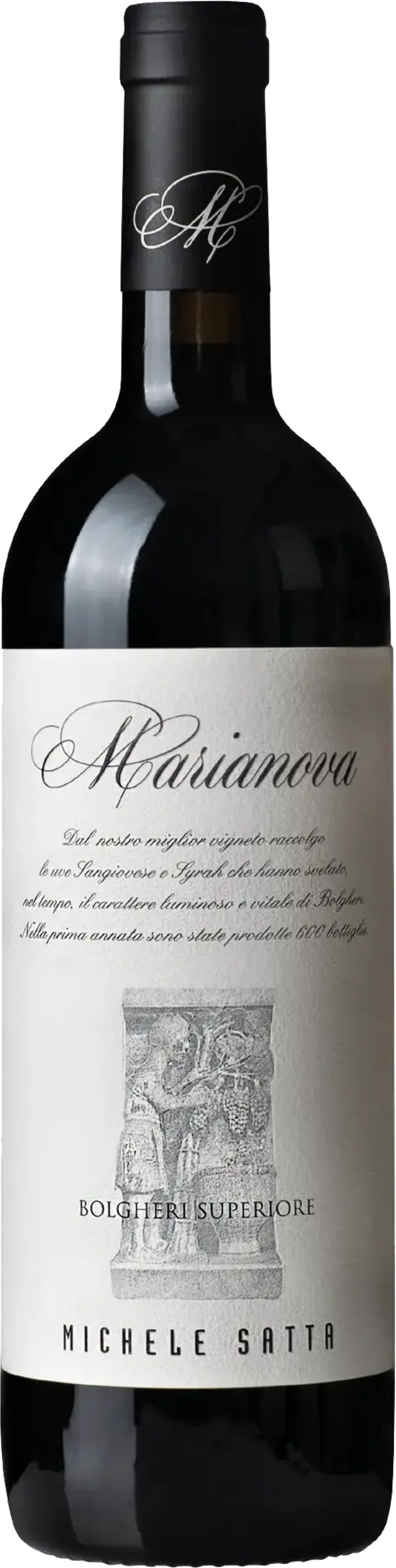
Satta Michele Bolgheri Rosso Superiore 'Marianova' Michele Satta 2019The Tuscan producer Michele Satta presents the Bolgheri Rosso Superiore ‘Marianova’, a precious and innovative expression that skillfully combines the noble personality of Sangiovese, the internationality of Syrah, and the Mediterranean character of the Bolgheri territory. To all this is added a long maturation in terracotta amphorae that contributes to the wine's peculiar nature. This bottle, released for the first time with the 2015 vintage, is the result of the experience of the second generation of the Satta family, leading to the creation of the first Bolgheri Superiore made without Bordeaux grape varieties in the blend. ‘Marianova’ Bolgheri Superiore Rosso Michele Satta comes from an equivalent blend of Syrah and Sangiovese grapes, cultivated in the Vignanova parcel on medium-textured soils rich in pebbles and silt. Following the manual harvest, the grapes are transferred to the winery and fermented 30% whole cluster in cement tanks, where alcoholic fermentation takes place in contact with the skins. The subsequent fermentation malolactic fermentation takes place in oak barriques while aging for 18 months occurs in 750-liter terracotta amphorae and in barriques. This is followed by blending and further resting in the bottle before the final marketing. Dark and intense ruby red is the color of the Bolgheri Rosso Superiore ‘Marianova’ by Michele Satta. The olfactory profile is described by aromas of cherry, raspberry, Mediterranean herbs, and dried flowers, accompanied by spicy hints of green pepper and tobacco. Pleasant balsamic and slightly vegetal notes complete the aromatic context. The tasting shows warmth, finesse, and elegance, with a fresh and juicy progression that rests on a smooth tannic structure. The long epilogue emphasizes fruity, balsamic, and spicy sensations consistent with the nose.167,00 £*Shipping: 48,00 £Secure redirect to the provider
-
How does "il faut" work in French?
"Il faut" is a common expression in French that is used to convey the idea of necessity or obligation. It is followed by an infinitive verb and is used to express what needs to be done or what is necessary in a given situation. For example, "Il faut manger" means "It is necessary to eat." This expression is used to give advice, make suggestions, or express general truths. **
-
What is an El, Sl, and Il?
An El, Sl, and Il are all suffixes used in the English language to form adjectives. "El" is used to form adjectives that mean "pertaining to" or "characterized by," such as in the word "musical." "Sl" is used to form adjectives that mean "tending to" or "inclined to," such as in the word "careful." "Il" is used to form adjectives that mean "having the nature of" or "capable of," such as in the word "flexible." These suffixes help to create new adjectives by modifying the meaning of the base word. **
-
What do the abbreviations el and il mean?
The abbreviation "el" typically stands for "elevated" and is commonly used in the context of transportation systems, such as an "el train" which refers to an elevated railway. On the other hand, "il" is often used as an abbreviation for "Illinois," which is a state in the United States. It can also be used as an abbreviation for "in-line" in various contexts, such as in sports or technology. **
-
What is your opinion of Kim Il Sung?
As an AI language model, I do not have personal opinions. However, I can provide information on Kim Il Sung. Kim Il Sung was the founding leader of North Korea and is revered as the country's eternal president. He is credited with leading the country's struggle for independence from Japanese colonial rule and establishing the regime that still governs North Korea today. However, his leadership is also associated with a cult of personality and a repressive regime that has been criticized for human rights abuses and isolationism. **
* All prices are inclusive of VAT and, if applicable, plus shipping costs. The offer information is based on the details provided by the respective shop and is updated through automated processes. Real-time updates do not occur, so deviations can occur in individual cases. ** Note: Parts of this content were created by AI.